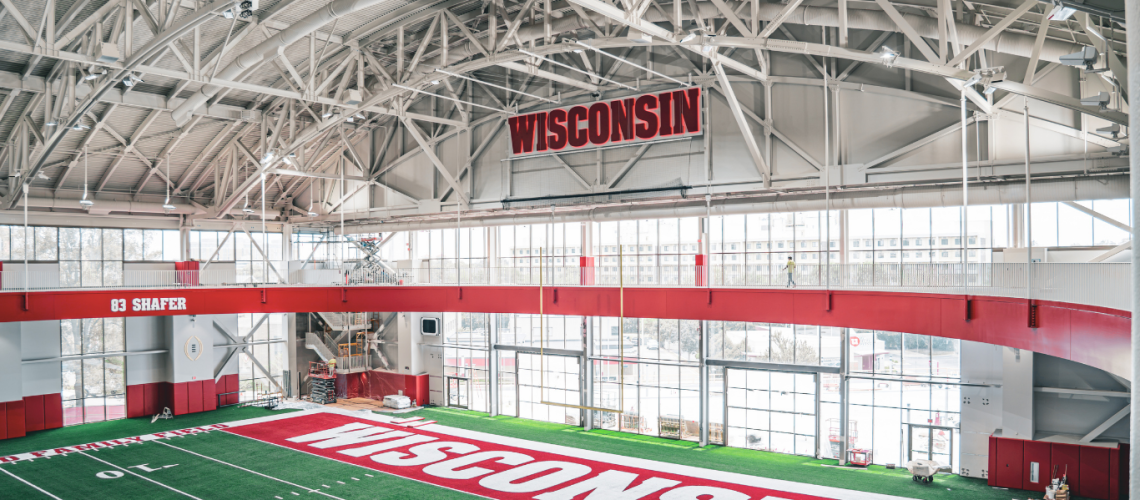
The $285 million Kellner Family Athletic Center represents the largest capital project in Wisconsin Athletics history.
Designed using ideas and best practices from leading collegiate and professional athletic facilities, the project creates a premier training and performance environment for Wisconsin’s 23 varsity sports while making a significant investment in the future of the athletics program.
For Westphal & Company and Globalcom Technologies, Phase 1 required much more than powering a new building.
Together, the teams delivered more than $12 million in electrical and low-voltage work while navigating a football-driven completion schedule, integrating sophisticated athletic technology, maintaining critical infrastructure across an active campus, and preparing existing systems for future construction.
A Technology-Rich Athletic Environment
At the center of Phase 1 is a 120-yard indoor turf field and 305-meter indoor training track. The facility also includes football coaching, recruiting, technology, hospitality, and support spaces.
Football coaching offices include space for the head coach, offensive and defensive coordinators, and additional coaches. A hospitality and recruiting area was designed to showcase Wisconsin Athletics to prospective student-athletes, with the head coach’s office and hospitality area sharing a viewing deck overlooking the indoor field.
Technology is integrated throughout the facility.
A high-tech football video room connects to an 8K camera system used for practice filming and video review. Player tracking, camera tracking, networking, communications, and other technology infrastructure support the demands of a modern collegiate athletics program.
Westphal and Globalcom’s scope included 15 kV electrical distribution, power distribution, high-performance sports lighting, DMX lighting controls, fire alarm, lightning protection, EV charging infrastructure, security cameras, access control, structured cabling, fiber optics, cellular and emergency responder DAS systems, telecommunications rooms, wireless infrastructure, and player and camera tracking systems.
AV infrastructure supports the Daktronics video board, digital signage, televisions, field audio, and outdoor plaza audio.
The result is a highly integrated environment where electrical power, lighting, networking, video, communications, security, AV, and athletic technology all have to perform together.
More Than a Practice Facility
The scale of the project extends well beyond the indoor field.
A full level of parking is located beneath the field, adding another layer of electrical, communications, security, and life-safety infrastructure.
The project also incorporates a Veterans Plaza with outdoor gathering and hospitality space and a concession area. Two large bi-folding doors allow the plaza to open directly into the indoor facility, creating a flexible indoor-outdoor environment for events and gatherings.
Additional spaces associated with the project include a temporary weight room, the conversion of dining space into sports medicine space, and a new tailgate area.
Together, these elements make the Kellner Family Athletic Center more than a football practice facility. It is a flexible, technology-rich environment designed to support athletics, recruiting, events, and the broader Wisconsin Athletics community.
Delivering on a Football-Driven Schedule
One of the project’s biggest challenges was a deadline that could not move.
Phase 1 had to be ready for Wisconsin Football to use the new facility for its 2026 training camp and preparation for the football season.
Meeting that operational deadline required thousands of electrical and technology components to be installed, tested, commissioned, and coordinated with numerous trades and vendors.
Westphal and Globalcom performed extensive elevated installations while coordinating multiple systems and trades under a compressed schedule.
As critical completion milestones approached, manpower increased, shifts were extended, and installation, testing, commissioning, and cutover activities took place simultaneously.
BIM coordination between Westphal’s field and BIM teams played an important role throughout the process. The teams coordinated electrical, lighting, AV, and technology systems, identified routing conflicts, responded to engineering changes, and adapted installations to actual field conditions.
That coordination helped keep a highly complex installation moving toward a fixed operational deadline.
Rebuilding Campus Infrastructure for What Comes Next
Building Phase 1 was only part of the assignment.
Westphal and Globalcom also had to prepare the existing campus for future development of the Kellner project.
To clear the way for demolition of the McClain Center and future Phase 2 construction, existing electrical distribution, fiber optic backbone, structured cabling, fire alarm, security, access control, and other low-voltage systems had to be rerouted or relocated.
All of that work had to happen while maintaining service to the existing campus.
The process required extensive planning and coordination, numerous shutdowns and cutovers, testing, and carefully managed transitions from existing infrastructure to new routes and systems.
Phase 1 infrastructure was also planned with future construction in mind. Certain systems were rerouted, extended, or installed to accommodate future construction and system requirements.
Building Today While Preparing for Tomorrow
The Kellner Family Athletic Center brought together an unusual combination of challenges: a nationally significant athletic facility, sophisticated technology, a hard deadline driven by the 2026 football season, active campus infrastructure that had to remain operational, extensive system cutovers, and future construction that had to be anticipated during Phase 1.
Westphal and Globalcom helped deliver the electrical and technology backbone of the new facility while simultaneously reconfiguring the surrounding campus to make the next phase of development possible.
The work was not simply about building what Wisconsin Athletics needed today.
It was about delivering today’s facility while preparing the campus for what comes next.